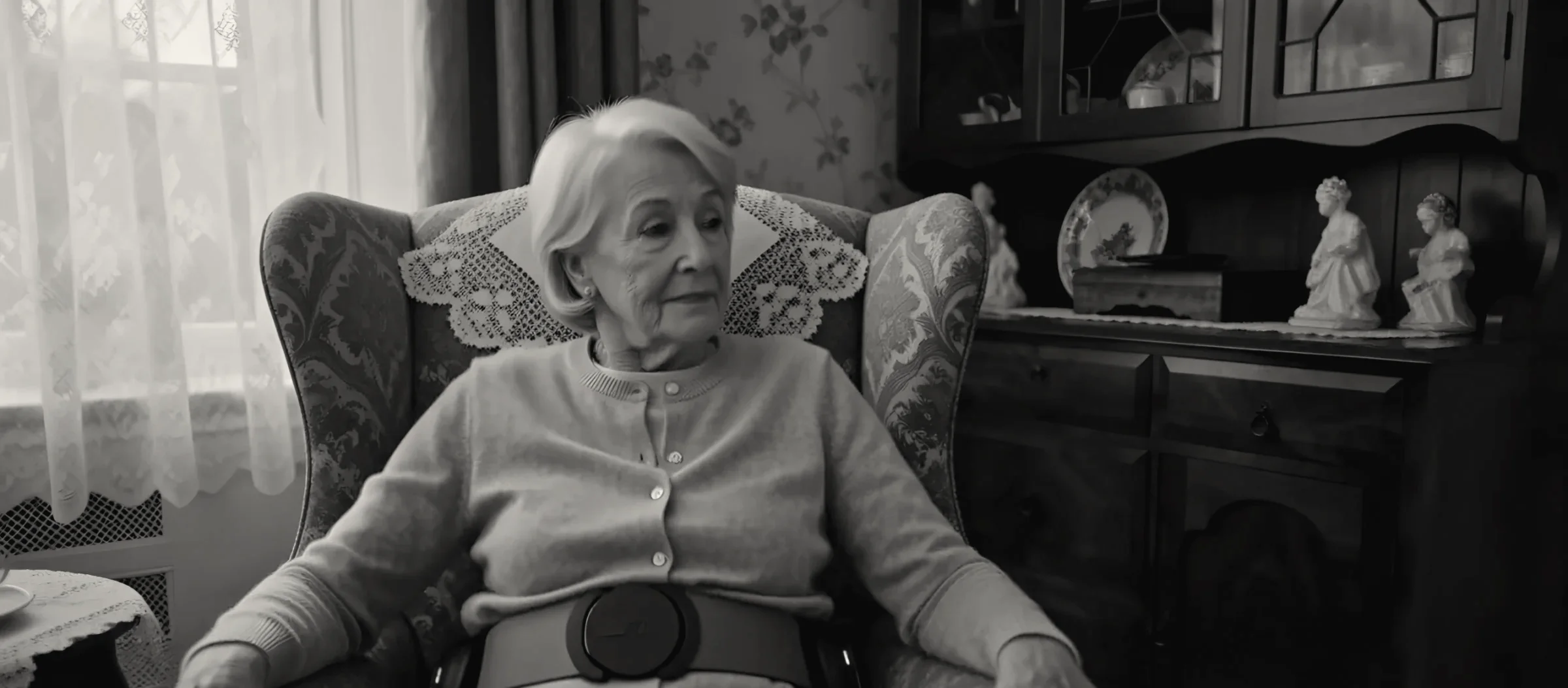
Why standing up gets so hard.
In one study, young adults stood up using about 42 percent of their leg strength. Healthy older adults used about 80 percent. That leaves little margin for a bad day or a low chair.
Count them tomorrow. Out of bed, off the sofa, off the toilet, out of the car, up from the kitchen table. Across studies that have counted them, groups of adults averaged between 33 and 71 sit-to-stands a day.1 Nobody notices. Then, for many older people, it becomes one of the hardest things they do all day.
A small move with a large load
Standing up looks simple, but it is a carefully timed sequence. The body leans forward to build momentum, lifts off the seat, straightens at the hips and knees, and then steadies itself.2 Biomechanics researchers describe it as one of the most mechanically demanding things we do in daily life. The hips and knees share the work, and one modelling study concluded that the knee's ability to produce force is likely a more important limit than the hip's.3
Working at the edge of your strength
For a young adult, standing up uses a modest share of the strength available. For an older adult, it can use most of it. In a study comparing 14 healthy older adults, average age 74, with 13 young adults, rising from a chair took about 80 percent of the older group's maximum leg strength, against 42 percent for the young group. Stairs showed a similar gap.4
Everyday moves take a much larger share of strength with age
Effort needed, as a share of maximum leg strength
Young adults, average age 22Older adults, average age 74
Source: Hortobágyi et al., Journals of Gerontology (2003). A small study with wide variation between people.
The older adults in that study had about 60 percent lower maximum leg strength than the young ones.4 Working that close to the limit leaves very little margin. A slightly lower chair, a bad day, a sore knee or a few weeks of inactivity can be enough to tip a person from managing to not managing.
The chair is part of the problem
Seat height matters more than it looks. A higher seat reduces the effort needed at the knee by up to 60 percent and at the hip by up to 50 percent, and pushing on armrests cuts the load at the hip by about half.5 At the other extreme, one study of functionally impaired older adults reported rising from a low chair at up to 97 percent of maximum knee extensor strength.3
This is why a low sofa, a deep armchair, a low toilet or a car seat can be impossible for someone who manages a dining chair with arms. Many homes are full of exactly the furniture that makes standing up hardest.

Strength fades faster than muscle
We lose muscle as we age. We lose strength much faster. Around age 75, men lose 3 to 4 percent of their strength a year and women 2.5 to 3 percent, and studies that measure both find strength falling two to five times faster than muscle mass. In one five-year study of 1,678 older people, men lost about 16 percent of their thigh strength but only 5 percent of their thigh muscle.6
Power, the ability to produce force quickly, falls faster still. Across age groups of healthy people aged 65 to 89, leg power was about 3.5 percent lower for each year of age, against 1 to 2 percent for strength,7 and power declines earlier and more steeply than strength with age.8 Rising from a chair is a power task, which may help explain why it is often among the first things to become difficult. It matters for more than comfort: losing strength is a more consistent risk factor for disability and death than losing muscle mass.6
A test you can do at home
Because standing up is so revealing, clinicians use it as a test. In the 30-second chair stand, part of the CDC's STEADI falls programme, a person sits on a straight-backed chair without armrests, about 17 inches (43 cm) high, with arms crossed, and stands up fully and sits back down as many times as they can in 30 seconds. A below-average score indicates a higher risk of falling.9 Scores correlate moderately well with measured leg strength.10
When is a 30-second chair stand score below average?
| Age | Men, fewer than | Women, fewer than |
|---|---|---|
| 60 to 64 | 14 | 12 |
| 65 to 69 | 12 | 11 |
| 70 to 74 | 12 | 10 |
| 75 to 79 | 11 | 10 |
| 80 to 84 | 10 | 9 |
| 85 to 89 | 8 | 8 |
| 90 to 94 | 7 | 4 |
Source: CDC STEADI, Assessment: 30-Second Chair Stand.
If your parent tries it, or you do: use a sturdy chair without wheels, placed against a wall, and have someone stand right next to them. If they cannot stand up without using their arms, do not do the test. Stop at once if there is pain, dizziness or shortness of breath. If they have fallen recently or had hip or knee surgery, ask a doctor or physiotherapist first. It is a screening test, not a diagnosis.
In a study of 1,122 adults aged 71 and over with no disability, those with the lowest scores on a short battery of tests that included chair rises were 4.2 to 4.9 times as likely as those with the highest scores to be disabled four years later.11
What training can change
This is also one of the parts of ageing that training can change. A Cochrane review of 121 trials with about 6,700 older participants looked at progressive resistance training, exercise against gradually increasing weight. Across the 11 trials, with 384 people, that measured it, training had a moderate to large effect on the ability to get out of a chair.12 Improvements in tasks like rising from a chair and climbing stairs were generally larger than improvements in walking speed.13 Serious side effects were rare, though many trials recorded side effects poorly.12 Faster power training appears to add a modest extra benefit, although the evidence is still of low certainty.14
Strength training is not a cure. It takes months, it has to be kept up, and many people with pain or frailty find it hard to start. But the gap between what a body can do and what a chair demands can be narrowed from both sides: by making people stronger, and by making the task lighter.
Why we started here
Veema starts with this movement. The exoskeleton adds strength at the hip and knee during a rise that the person starts themselves, so that standing up takes less of what they have.
These figures describe the need. They are not results or claims about Veema.
Sources
- Bohannon, Journal of Physical Therapy Science (2015): systematic review of 10 studies; group mean daily sit-to-stands ranged from 33 to 71.
- Schenkman et al., Physical Therapy (1990): four phases of rising: flexion-momentum, momentum transfer, extension and stabilisation.
- Yoshioka et al., BioMedical Engineering OnLine (2007): sit-to-stand one of the most mechanically demanding daily activities; knee moment ability a more influential limiting factor than the hip (modelling study); cites Hughes et al. (1996) reporting up to 97% of maximum isometric knee extensor strength in functionally impaired older adults rising from a low chair.
- Hortobágyi et al., Journals of Gerontology Series A (2003): 14 older (mean age 74) vs 13 young (mean age 22) adults; relative effort: chair rise 80% vs 42%, stair ascent 78% vs 54%, stair descent 88% vs 42%; older adults had 60% lower maximal leg press moments.
- Janssen, Bussmann and Stam, Physical Therapy (2002): a higher seat lowered moments at the knee by up to 60% and at the hip by up to 50%; using armrests lowered hip moments by 50%.
- Mitchell et al., Frontiers in Physiology (2012): at about 75, strength lost at 3 to 4% a year in men and 2.5 to 3% in women; strength lost 2 to 5 times faster than mass; in 1,678 older people over 5 years men lost about 16% of knee extensor strength but 5% of thigh muscle; loss of strength a more consistent risk for disability and death than loss of mass.
- Skelton et al., Age and Ageing (1994): cross-sectional study of healthy people aged 65 to 89: leg power about 3.5% lower per year of age vs 1 to 2% for strength.
- Reid and Fielding, Exercise and Sport Sciences Reviews (2012): muscle power declines earlier and more precipitously with advancing age than muscle strength.
- CDC STEADI, Assessment: 30-Second Chair Stand: protocol (straight-backed chair without arms, about 17 inches, arms crossed, score 0 if arms are needed) and below-average scores by age and sex; a below-average score indicates a risk for falls.
- Jones, Rikli and Beam, Research Quarterly for Exercise and Sport (1999): 76 community-dwelling older adults; test-retest reliability 0.84 to 0.92; correlation with weight-adjusted leg press 0.71 to 0.78.
- Guralnik et al., New England Journal of Medicine (1995): 1,122 non-disabled adults 71+; those with the lowest performance scores were 4.2 to 4.9 times as likely to have disability at four years as those with the highest.
- Liu and Latham, Cochrane Review (2009): 121 trials, 6,700 participants; progressive resistance training had a moderate to large effect on getting out of a chair (11 trials, 384 participants, SMD -0.94); serious adverse events rare but poorly recorded.
- Cochrane, plain language summary of Liu and Latham: improvement in getting out of a chair or stair climbing generally greater than in walking speed.
- Balachandran et al., JAMA Network Open (2022): power training vs traditional strength training: low-certainty improvement in physical function measured by performance tests (SMD 0.30).