The losses nobody sees.
Growing old is rarely one event. It is a run of small losses, and in Europe and the United States they are happening to tens of millions of people.
Ask someone what growing old takes away and they will usually name one thing: a diagnosis, a fall, a move. The data tells a quieter story. Old age is mostly a run of small losses, each one easy to shrug off, that together decide how the last third of a life is lived. In Europe and in the United States, every one of them is happening to millions of people right now.
The healthy years
Retirement is meant to be the reward. For most people it is also when health starts to run out. A 65-year-old in the European Union can expect to live another 20.2 years, but only 9.4 of them free of disability.1 That is fewer than half. In the United States the measure is different but the picture is the same: of the 23.3 years an American can expect after 60, the World Health Organization estimates that the equivalent of 7.5 are lost to illness and disability.2
Most of the years after retirement are not healthy ones
Expected remaining years of life, split by health
Healthy years (EU 9.4, US 15.8)Years with illness or disability (EU 10.8, US 7.5)
Sources: Eurostat (2023), years without activity limitation; World Health Organization (2023), healthy life expectancy. The two are measured differently.
In Europe that is almost eleven years of mornings that start with a small calculation: how are the knees today, and is it worth going out.
The everyday
Independence is rarely lost all at once. It goes one task at a time. Across the EU, 24 percent of people over 65 have difficulty with personal care, things like washing, dressing or getting in and out of bed, and almost half struggle with at least one household task such as shopping, cooking or cleaning.3
In the United States, about two million older people are completely or mostly homebound. Another 12 percent can only leave home with help or with difficulty.4 Nobody decides to stop going out. The walk to the bakery gets planned, then postponed, then handed to someone else.
The help that does not come
Needing help is hard. Needing it and not getting it is harder. Nearly half of older Europeans who struggle with daily care or household tasks say they lack the help they need.3 In the United States, 32 percent of older people living at home who have difficulty, or who get help, went without in the last month alone.5
Behind each of those numbers is an ordinary afternoon. The bath that did not happen. The meal skipped because the stove felt too far away. A phone call to a son or daughter who lives two hours away and cannot come today.
The home
When the house becomes too hard, a whole life moves into one room. The European Union has about 3.6 million beds in nursing and residential care homes, close to the population of Berlin.6 In the United States, 1.2 million people live in nursing homes, spread across about 14,700 of them.7
The move rarely feels like a choice. It tends to follow a fall, a hospital stay or a crisis, and decades in one house end in a decision made in a few days.
The last chapter
Most people would choose to spend their last days at home. Across OECD countries, more than half of deaths still happen in hospital.8 And the losses are felt: worldwide, about one in seven people aged 70 and over lives with a mental health condition, most often anxiety or depression.9
The same losses on both sides of the Atlantic
| European Union | United States | |
|---|---|---|
| Healthy years | 9.4 of 20.2 after 65 | 7.5 of 23.3 lost after 60 |
| Daily independence | 24% struggle with personal care | About 2 million homebound |
| Help that does not come | 47% lack the help they need | 32% went without last month |
| Leaving home | 3.6 million care home beds | 1.2 million nursing home residents |
Sources: Eurostat; World Health Organization; JAMA Internal Medicine; The Milbank Quarterly; CDC. Full notes below.
Why it matters
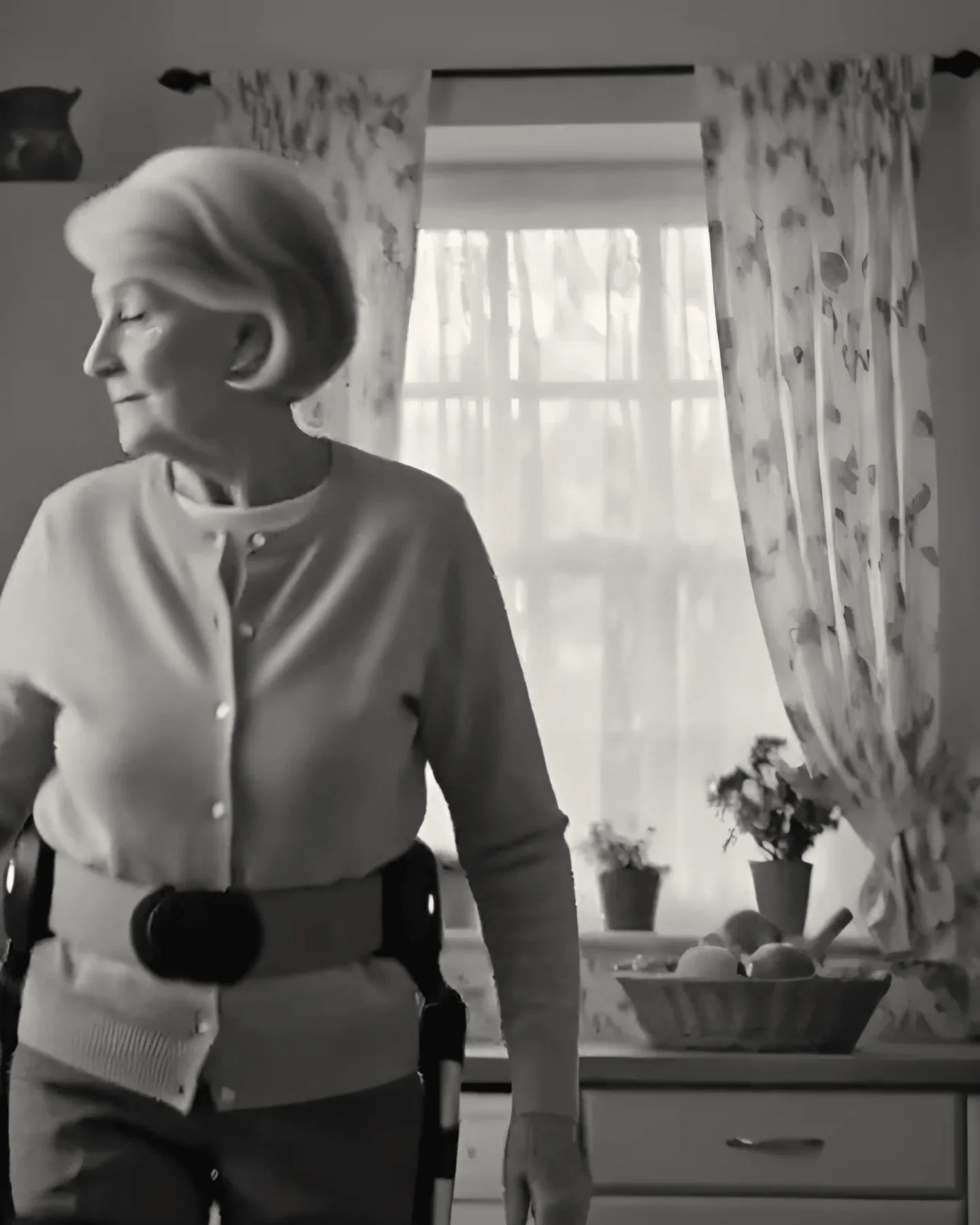
None of these losses makes the news. They arrive one at a time, in kitchens and hallways: a parent who stops mentioning the stairs, a family that only notices once the stairs are gone. Across Europe and the United States they are happening to tens of millions of people, and to the families who love them.
Most of them start in the same place, the moment standing up, walking or bending stops feeling safe. That is the part we think can change, and it is why we built Veema.
These figures describe the need. They are not results or claims about Veema.
Sources
- Eurostat, Healthy life years (hlth_hlye), EU-27, 2023: life expectancy at 65 of 20.2 years; 9.4 healthy life years at 65 (46.6% of remaining life). Provisional estimates.
- World Health Organization, Global Health Observatory, United States, 2023: life expectancy at 60 of 23.3 years; healthy life expectancy (HALE) at 60 of 15.8 years.
- Eurostat, Disability statistics: elderly needs for help or assistance (EHIS 2019): 23.6% of people 65+ limited in at least one personal care activity; 47.4% in at least one household activity; 46.6% of older people with such difficulties report a lack of assistance.
- Ornstein KA, et al. Epidemiology of the homebound population in the United States. JAMA Internal Medicine (2015): about 395,000 completely and 1.58 million mostly homebound Medicare beneficiaries in 2011; 11.7% more left home only with help or difficulty.
- Freedman VA, Spillman BC. Disability and care needs among older Americans. The Milbank Quarterly (2014): 32% of older adults living outside nursing homes with difficulty or help had an adverse consequence related to an unmet need in the last month.
- Eurostat, Long-term care beds in nursing and residential care facilities (hlth_rs_bdltc), EU-27, 2024: 3,592,788 beds.
- CDC, National Center for Health Statistics, Nursing Home Care FastStats: 14,700 nursing homes and 1.2 million residents (2022).
- OECD, Time for Better Care at the End of Life (2023): more than half of deaths still occur in hospital across OECD countries; home is generally the preferred place of death.
- World Health Organization, Mental health of older adults fact sheet (2026): 14.75% of adults aged 70 and over lived with a mental disorder in 2023, most commonly anxiety or depression.